Convert to TS1: Difference between revisions
| (10 intermediate revisions by 4 users not shown) | |||
| Line 1: | Line 1: | ||
=Introduction= |
=Introduction= |
||
'''convert_to_ts1.exe''' converts output from hydrologic models to the .ts1 format recognised by TUFLOW. |
'''convert_to_ts1.exe''' converts output from hydrologic models to the .ts1 format recognised by TUFLOW. The .ts1 format is a .csv file that includes indexing and header information, significantly reducing the time required for TUFLOW to read inflow hydrographs. If numerous inflow hydrographs are present, use of this format is strongly recommended. |
||
Any number of input files (of the same format) can be specified and wildcards ( |
Any number of input files (of the same format) can be specified, and wildcards (e.g. “*.out”) may be used to select a group of files. The available options are described in the table below. One input format switch and one output format switch should be specified. However, the output format defaults to ts1, so this flag may be omitted. |
||
| ⚫ | For most options, an additional file “_peak_Q.csv” is |
||
| ⚫ | |||
| ⚫ | For most options, an additional file “_peak_Q.csv” is produced, summarising the peak flows for each hydrograph. If a group of files is specified, the _peak_Q.csv file summarises all files within the group, and a second file “_peak_F.csv” identifies which file produced the peak flow across all files. This is useful for determining which storm duration produced the peak flow (i.e. the critical duration event). |
||
| ⚫ | |||
| ⚫ | |||
| ⚫ | |||
=Options= |
=Options= |
||
'''TABLE 1: convert_to_ts1 Options (Switches)''' |
'''TABLE 1: convert_to_ts1 Options (Switches)''' |
||
| Line 20: | Line 25: | ||
|"-rows"|| The inflow hydrographs are in space or comma delimited files with the data in blocks of one or more rows for each hydrograph. No time data exists in the input files. |
|"-rows"|| The inflow hydrographs are in space or comma delimited files with the data in blocks of one or more rows for each hydrograph. No time data exists in the input files. |
||
|- |
|- |
||
|"-urbs"|| Input files are URBS .q files. |
|"-urbs"|| Input files are URBS .q files, which must use relative time in hours from the start of the hydrograph. |
||
|- |
|- |
||
|"-wbnm"|| Input files are WBNM _Meta.out files.<br> |
|"-wbnm"|| Input files are WBNM _Meta.out files.<br>Only outputs in the .ts1 format. Two files are created: |
||
Only outputs in the .ts1 format. Two files are created:<br> |
|||
*loc_.ts1 containing the local hydrographs. |
*loc_.ts1 containing the local hydrographs. |
||
*tot_.ts1 containing the total hydrographs. |
*tot_.ts1 containing the total hydrographs. |
||
| Line 40: | Line 44: | ||
|- |
|- |
||
|- |
|- |
||
|"-mr event_names.txt"|| Multiple Rafts Durations: Read multiple durations from a rafts *.loc or *.tot file. Must be used in conjunction with the -rafts switch. |
|"-mr event_names.txt"|| Multiple Rafts Durations: Read multiple durations from a rafts *.loc or *.tot file. Must be used in conjunction with the -rafts switch. Events are read directly from the *.out file. Names of each event are extracted from the text file event_names.txt (refer example below). The order of the durations in event_names.txt has to be the same as the order of ticked durations in XPRAFTS. Please note: Routing increments must be the same for all storm durations. Multiple file processing using the * wildcard feature not yet supported with the -mr switch enabled. |
||
|- |
|- |
||
!colspan="2" style="background-color:#005581; font-weight:bold; color:white;"| Miscellaneous Switches |
!colspan="2" style="background-color:#005581; font-weight:bold; color:white;"| Miscellaneous Switches |
||
| Line 56: | Line 60: | ||
=Examples= |
=Examples= |
||
<ol> |
|||
| ⚫ | |||
<li>Outputs two .ts1 files, one the local hydrographs and the other for the total hydrographs in Q100_Meta.out.<br> |
|||
| ⚫ | |||
| ⚫ | |||
<tt>convert_to_ts1.exe -rorb -ts1 -dt5 *.out</tt |
<tt>convert_to_ts1.exe -rorb -ts1 -dt5 *.out</tt> |
||
| ⚫ | |||
<li>Outputs .ts1 from .int file.<br> |
|||
<tt>convert_to_ts1.exe - |
<tt>convert_to_ts1.exe -xp -ts1 Q100.int</tt> |
||
<li>Outputs .ts1 files for every Q100 .loc and .tot file in the folder. A summary of the peak flows can be found in the _peak_Q.csv and _peak_F.csv files.<br> |
|||
| ⚫ | |||
| ⚫ | |||
| ⚫ | |||
<tt>convert_to_ts1.exe -rafts -csv -thour Q100.tot Q050.tot Q100.loc Q050.loc</tt> |
|||
| ⚫ | |||
| ⚫ | |||
<tt>convert_to_ts1.exe -rafts -mr event_names.txt -e0 -csv my_results.tot</tt><br> |
<tt>convert_to_ts1.exe -rafts -mr event_names.txt -e0 -csv my_results.tot</tt><br> |
||
<br> |
|||
| ⚫ | |||
[[File:RAFTS Storm Control.png | 500px]]<br> |
[[File:RAFTS Storm Control.png | 500px]]<br> |
||
<br> |
<br> |
||
| ⚫ | |||
<tt>convert_to_ts1.exe -wbnm -mw -csv Q100.out</tt><br> |
<tt>convert_to_ts1.exe -wbnm -mw -csv Q100.out</tt><br> |
||
<br> |
|||
| ⚫ | |||
</ol> |
|||
{{Tips Navigation |
{{Tips Navigation |
||
Latest revision as of 12:06, 18 March 2026
Introduction
convert_to_ts1.exe converts output from hydrologic models to the .ts1 format recognised by TUFLOW. The .ts1 format is a .csv file that includes indexing and header information, significantly reducing the time required for TUFLOW to read inflow hydrographs. If numerous inflow hydrographs are present, use of this format is strongly recommended.
Any number of input files (of the same format) can be specified, and wildcards (e.g. “*.out”) may be used to select a group of files. The available options are described in the table below. One input format switch and one output format switch should be specified. However, the output format defaults to ts1, so this flag may be omitted.
For most options, an additional file “_peak_Q.csv” is produced, summarising the peak flows for each hydrograph. If a group of files is specified, the _peak_Q.csv file summarises all files within the group, and a second file “_peak_F.csv” identifies which file produced the peak flow across all files. This is useful for determining which storm duration produced the peak flow (i.e. the critical duration event).
The program currently supports the hydrology models most commonly used within Australia. Additional formats can be incorporated by supplying example files/formats and relevant information to support@tuflow.com.
The .ts1 file format is outlined on the following page: TS1 File Format.
Options
TABLE 1: convert_to_ts1 Options (Switches)
| Switch | Description |
|---|---|
| Input File Format Switches | |
| "-rafts" | Input files are XP-RAFTS .tot and .loc files. |
| "-rorb" | Input files are RORB .out files. The dt option must also be specified. |
| "-rows" | The inflow hydrographs are in space or comma delimited files with the data in blocks of one or more rows for each hydrograph. No time data exists in the input files. |
| "-urbs" | Input files are URBS .q files, which must use relative time in hours from the start of the hydrograph. |
| "-wbnm" | Input files are WBNM _Meta.out files. Only outputs in the .ts1 format. Two files are created:
|
| "-xp" | Input files are XP-SWMM .int or .ext files. |
| Output File Format Switches | |
| "-csv" | Output file(s) in .csv format. |
| "-ts1" | Output file(s) in .ts1 format (the default). |
| RAFTS and WBNM Specific Switches | |
| "-mw" | Multiple WBNM Durations: Read multiple durations from a wbnm *.out file. Must be used in conjunction with the -wbnm switch. Event names are read directly from the *.out file. Please note: Multiple file processing using the * wildcard feature not yet supported with the -mw switch enabled. |
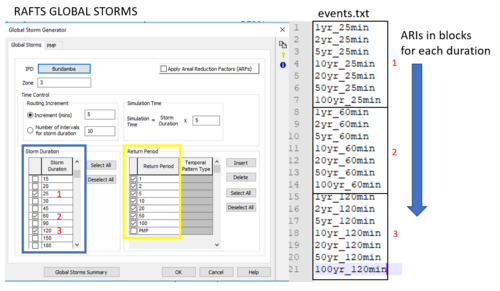
| "-mr event_names.txt" | Multiple Rafts Durations: Read multiple durations from a rafts *.loc or *.tot file. Must be used in conjunction with the -rafts switch. Events are read directly from the *.out file. Names of each event are extracted from the text file event_names.txt (refer example below). The order of the durations in event_names.txt has to be the same as the order of ticked durations in XPRAFTS. Please note: Routing increments must be the same for all storm durations. Multiple file processing using the * wildcard feature not yet supported with the -mr switch enabled. |
| Miscellaneous Switches | |
| "-b" | Batch mode. Suppresses prompt to press Enter at end of processing. Used in .bat files where two or more files are to be processed in succession. |
| "-dt<dt>" | Time increment of RORB hydrographs in minutes. For example, 5 minutes would be specified as dt5. |
| "-s0" | Insert a zero flow before the start of the hydrograph. |
| "-e0" | Insert a zero flow after the end of the hydrograph. |
| "-thour" | Output time in hours (for .csv output format only). |
Examples
- Outputs two .ts1 files, one the local hydrographs and the other for the total hydrographs in Q100_Meta.out.
convert_to_ts1.exe -wbnm -ts1 Q100_Meta.out - Outputs .ts1 files for every .out file in the folder. A summary of the peak flows can be found in the _peak_Q.csv and _peak_F.csv files.
convert_to_ts1.exe -rorb -ts1 -dt5 *.out - Outputs .ts1 from .int file.
convert_to_ts1.exe -xp -ts1 Q100.int - Outputs .ts1 files for every Q100 .loc and .tot file in the folder. A summary of the peak flows can be found in the _peak_Q.csv and _peak_F.csv files.
convert_to_ts1.exe -rafts -ts1 Q100*.loc Q100*.tot - Outputs .csv files for the four files specified. The output time is in hours.
convert_to_ts1.exe -rafts -csv -thour Q100.tot Q050.tot Q100.loc Q050.loc - Outputs a separate .csv file for each duration specified within event_names.txt and the result my_results.tot. The order of the durations in event_names.txt is important and has to be the same as the order of ticked durations in XPRAFTS. Example is shown below.
convert_to_ts1.exe -rafts -mr event_names.txt -e0 -csv my_results.tot
- Outputs a separate .csv file for each event within the wbnm output file Q100.out.
convert_to_ts1.exe -wbnm -mw -csv Q100.out

| Up |
|---|
 Back to TUFLOW Utilities Back to TUFLOW Utilities
|