TUFLOW SWMM Tutorial M04: Difference between revisions
Chris Huxley (talk | contribs) |
Chris Huxley (talk | contribs) |
||
| Line 11: | Line 11: | ||
= Simulation Control Files = |
= Simulation Control Files = |
||
TUFLOW's automated event management operates by introducing wildcard referencing into the boundary condition database. |
TUFLOW's automated event management operates by introducing wildcard referencing into the boundary condition database. |
||
| ⚫ | |||
| ⚫ | |||
| ⚫ | |||
| ⚫ | |||
| ⚫ | This tutorial example will upgrade our single simulation model to run six (six) event simulations. The simulations will cater for three (3) Annual Exceedance Probability (AEP) event magnitudes: 5%, 2% and 1% AEP (in Average |
||
| ⚫ | This tutorial example will upgrade our single simulation model to run six (six) event simulations. The simulations will cater for three (3) Annual Exceedance Probability (AEP) event magnitudes: 5%, 2% and 1% AEP (in Average Recurrence Interval (ARI) terminology, this translates to the 1 in 20, 50 and 100 year ARI events). The design storms will be simulated for two (2) event storm durations: 1 and 2 hour. |
||
=== TUFLOW Boundary Condition Database (bc_dbase) === |
=== TUFLOW Boundary Condition Database (bc_dbase) === |
||
| Line 26: | Line 28: | ||
<li>Event Duration = DUR |
<li>Event Duration = DUR |
||
<li>Navigate to the '''TUFLOW_SWMM_Module_04\Tutorial_Data''' folder. Copy and paste the following files to the ''' TUFLOW_SWMM_Module_04\TUFLOW\bc_dbase''' folder. These files |
<li>Navigate to the '''TUFLOW_SWMM_Module_04\Tutorial_Data''' folder. Copy and paste the following files to the ''' TUFLOW_SWMM_Module_04\TUFLOW\bc_dbase''' folder. These files contain the inflows for each event magnitude and duration. |
||
:*TS04_inflow_05p1hr.csv |
:*TS04_inflow_05p1hr.csv |
||
:*TS04_inflow_05p2hr.csv |
:*TS04_inflow_05p2hr.csv |
||
| Line 40: | Line 42: | ||
:*TS04_rainfall_01p2hr.csv <br> |
:*TS04_rainfall_01p2hr.csv <br> |
||
The files with 'inflow' in their name are flow hydrograph boundary conditions sourced from an external hydrology model, such as HEC-HMS, RORB, URBS, WBNM etc. The files with 'rainfall' in their name are rainfall depth hyetographs used to define the rainfall timeseries in the SWMM urban hydrology section of the model. |
The files with 'inflow' in their name are flow hydrograph boundary conditions sourced from an external hydrology model, such as HEC-HMS, RORB, URBS, WBNM etc. The files with 'rainfall' in their name are rainfall depth hyetographs used to define the rainfall timeseries in the SWMM urban hydrology section of the model. |
||
<li>Save a copy of the '''bc_dbase.csv''' as '''bc_dbase_TS04_001.csv'''. |
<li>Save a copy of the '''bc_dbase.csv''' as '''bc_dbase_TS04_001.csv'''. |
||
| Line 66: | Line 69: | ||
<font color="blue"><tt> End Time </tt></font> <font color="red"><tt>==</tt></font> <font color="black"><tt> 2</tt></font> |
<font color="blue"><tt> End Time </tt></font> <font color="red"><tt>==</tt></font> <font color="black"><tt> 2</tt></font> |
||
</ol><font color="blue"><tt>End Define</tt></font> |
</ol><font color="blue"><tt>End Define</tt></font> |
||
<li> When TUFLOW runs a simulation it reads all of the defined events in the TEF, though only uses the event variables specified in the batch file. We will create a compatible batch file shortly.<br> |
<li> When TUFLOW runs a simulation, it reads all of the defined events in the TEF, though only uses the event variables specified in the batch file. We will create a compatible batch file shortly.<br> |
||
</ol> |
</ol> |
||
| Line 78: | Line 81: | ||
<font color="green"><tt>! EVENTS</tt></font> <br> |
<font color="green"><tt>! EVENTS</tt></font> <br> |
||
<font color="blue"><tt>Event File </tt></font> <font color="red"><tt>== </tt></font> <font color="black"><tt> TS04_Event_File.tef </tt></font> <font color="green"><tt> ! Reference the TUFLOW Event File</tt></font> <br> |
<font color="blue"><tt>Event File </tt></font> <font color="red"><tt>== </tt></font> <font color="black"><tt> TS04_Event_File.tef </tt></font> <font color="green"><tt> ! Reference the TUFLOW Event File</tt></font> <br> |
||
The location of this file in the TCF is important. If there are any commands associated with an event which overwrite other existing commands (such as End Time == in the example above), the TEF file needs to be processed last for the overwrite to occur. Referencing this file as the last line in the TCF ensures this order of |
The location of this file in the TCF is important. If there are any commands associated with an event which overwrite other existing commands (such as End Time == in the example above), the TEF file needs to be processed last for the overwrite to occur. Referencing this file as the last line in the TCF ensures this order of operation occurs as intended.<br> |
||
<li>Save the TCF. |
<li>Save the TCF. |
||
</ol> |
</ol> |
||
| Line 134: | Line 137: | ||
= Conclusion = |
= Conclusion = |
||
*Automated Event Management functionality was added to the TUFLOW SWMM model |
*Automated Event Management functionality was added to the TUFLOW SWMM model. |
||
*Multiple event simulations were run in sequence from a batch file. |
*Multiple event simulations were run in sequence from a batch file. |
||
*Creation of looped batch file was demonstrated for the |
*Creation of looped batch file was demonstrated for the efficient execution of bulk simulations. |
||
*Multiple event simulation results were inspected using the QGIS TUFLOW Viewer. |
*Multiple event simulation results were inspected using the QGIS TUFLOW Viewer. |
||
<br> |
<br> |
||
Revision as of 16:57, 18 January 2024
Introduction
This tutorial, Module 4 of the TUFLOW SWMM tutorial dataset will demonstrate TUFLOW's in-bulit event management functionality. This powerful functionality runs multiple event combinations (e.g. magnitude, duration, temporal patterns, climate change) using a single set of control files, rather than creating a new set of control files for every simulation. For example, without implementing event management a project requiring simulation of the following event combinations would require 144 TCF and bc_dbase files:
- 6 x Event Magnitude (AEP): 01p, 02p, 05p, 10p, 20p, 50p
- 8 x Event Duration (hour): 1h, 2h, 3h, 6h, 9h, 12h, 18h, 24h
- 3 x Climate Change Horizon: current climate, 2050, 2100
Using predefined naming conventions, with TUFLOW's event management functionality, all the events can be executed from a single TCF and bc_dbase file!
This feature of TUFLOW makes the management of the model files easier, ensures consistency between the simulations and improves project quality control by reducing the likelihood of human error associated with incorrect file referencing.
TUFLOW SWMM Tutorial Module 4 builds from the model created in TUFLOW SWMM Tutorial Module 3. The completed TUFLOW SWMM Module 3 model is provided in the TUFLOW_SWMM_Module_04\TUFLOW folder of the download dataset as the starting point for this tutorial. If you are not already familiar with TUFLOW SWMM linking, we recommend first completing Module 1, 2 and 3 before this tutorial.
Simulation Control Files
TUFLOW's automated event management operates by introducing wildcard referencing into the boundary condition database.
A new control file, called the "TUFLOW Event File" is added. It lists all event titles which are applied to the wildcard character in the boundary condition database. It also lists unique commands to associate with the specific events.
Models are executed using a batch file, with the event specifically listed as a variable in the batch file syntax.
This tutorial example will upgrade our single simulation model to run six (six) event simulations. The simulations will cater for three (3) Annual Exceedance Probability (AEP) event magnitudes: 5%, 2% and 1% AEP (in Average Recurrence Interval (ARI) terminology, this translates to the 1 in 20, 50 and 100 year ARI events). The design storms will be simulated for two (2) event storm durations: 1 and 2 hour.
TUFLOW Boundary Condition Database (bc_dbase)
The first task when updating a model with Event Management functionality is to update the bc_dbase.csv with event magnitude and event duration wildcard placeholders:
- We will use the following wildcard characters to represent the Events in our model:
- Event Magnitude = AEP
- Event Duration = DUR
- Navigate to the TUFLOW_SWMM_Module_04\Tutorial_Data folder. Copy and paste the following files to the TUFLOW_SWMM_Module_04\TUFLOW\bc_dbase folder. These files contain the inflows for each event magnitude and duration.
- TS04_inflow_05p1hr.csv
- TS04_inflow_05p2hr.csv
- TS04_inflow_02p1hr.csv
- TS04_inflow_02p2hr.csv
- TS04_inflow_01p1hr.csv
- TS04_inflow_01p2hr.csv
- TS04_rainfall_05p1hr.csv
- TS04_rainfall_05p2hr.csv
- TS04_rainfall_02p1hr.csv
- TS04_rainfall_02p2hr.csv
- TS04_rainfall_01p1hr.csv
- TS04_rainfall_01p2hr.csv
- Save a copy of the bc_dbase.csv as bc_dbase_TS04_001.csv.
- Open the file and make the following updates to the 'Source' column:
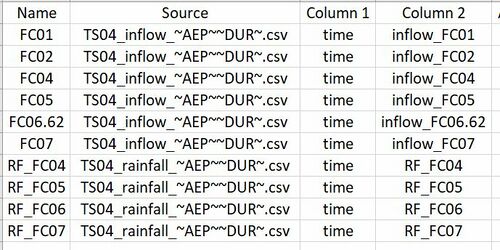
- Save bc_dbase_TS04_001.csv.

TUFLOW Event File (TEF)
- Navigate to the TUFLOW_SWMM_Module_04\Tutorial_Data folder. Copy the TS04_Event_File.tef to the TUFLOW_SWMM_Module_04\TUFLOW\runs folder.
- Open the TEF in a text editor. There are three event magnitudes and two event durations listed:
- Event Magnitudes: 5% , 2% and 1% AEP
- Event Durations: 1 and 2 hour
- The event specific commands are contained between the Define Event and End Define commands.
- The BC Event Source command is linked to the bc_dbase file. In the below examples, any occurrence of '~AEP~' in bc_dbase_TS04_001.csv will be replaced with '05p' and any occurrence of '~DUR~' in bc_dbase_TS04_001.csv will be replaced with '1hr'. Also, when the 1 hour event is called the simulation run end time will be set to 2 hours (instead of 3 hours, as per the other simulations).
! EVENT MAGNITUDES
Define Event == 05p- BC Event Source == ~AEP~ | 05p
! EVENT DURATIONS
Define Event == 1hr- BC Event Source == ~DUR~ | 1hr
End Time == 2
- When TUFLOW runs a simulation, it reads all of the defined events in the TEF, though only uses the event variables specified in the batch file. We will create a compatible batch file shortly.
TUFLOW Control File (TCF)
- Save a copy of TS03_5m_001.tcf as TS04_5m_~e1~_~e2~_001.tcf in the TUFLOW_SWMM_Module_04\TUFLOW\runs folder.
- Open the file TS04_5m_~e1~_~e2~_001.tcf in a text editor.
- Update the reference to the bc_dbase:
BC Database == ..\bc_dbase\bc_dbase_TS04_001.csv ! Reference the Boundary Conditions Database
- Add the following command to reference the TEF on the last line of the TCF:
! EVENTS
Event File == TS04_Event_File.tef ! Reference the TUFLOW Event File
The location of this file in the TCF is important. If there are any commands associated with an event which overwrite other existing commands (such as End Time == in the example above), the TEF file needs to be processed last for the overwrite to occur. Referencing this file as the last line in the TCF ensures this order of operation occurs as intended.
- Save the TCF.
Running the Simulation
- Save a copy of _run_TS03_HPC.bat as _run_TS04_HPC.bat in the TUFLOW_SWMM_Module_04\TUFLOW\runs folder.
- Update the batch file to reference the TS04_5m_~e1~_~e2~_001.tcf and include event switches (-e1, -e2) defining event magnitude and event duration:
set exe="..\..\..\exe\2023-03-AA\TUFLOW_iSP_w64.exe"
set run=start "TUFLOW" /wait %exe% -b
%run% -e1 05p -e2 1hr TS04_5m_~e1~_~e2~_001.tcf
%run% -e1 05p -e2 2hr TS04_5m_~e1~_~e2~_001.tcf
%run% -e1 02p -e2 1hr TS04_5m_~e1~_~e2~_001.tcf
%run% -e1 02p -e2 2hr TS04_5m_~e1~_~e2~_001.tcf
%run% -e1 01p -e2 1hr TS04_5m_~e1~_~e2~_001.tcf
%run% -e1 01p -e2 2hr TS04_5m_~e1~_~e2~_001.tcf
- Save the batch file and double click it in Windows File Explorer to run the simulation.
Troubleshooting
Did your TUFLOW SWMM model fail to run successfully? If so, here is a link to a troubleshooting guide: TUFLOW SWMM Troubleshooting.
Advanced Looping Batch File (Optional)
Looping batch files are a powerful tool to enable high volume simulation management with the least amount syntax. For example, the following looped batch file executed 1440 simulation using 15 lines of syntax!

We will convert our sequential formatted batch file to a looped format:
- Save a copy of _run_TS04_HPC.bat as _run_TS04_HPC_loop.bat in the TUFLOW_SWMM_Module_04\TUFLOW\runs folder.
- Add the following commands. Indentation is important in batch files, insert tabs to match the below spacing:
echo off
set exe="..\..\..\exe\2023-03-AA\TUFLOW_iSP_w64.exe"
set run=start "TUFLOW" /wait %exe% -b
set AEP=05p 02p 01p
set DUR=1hr 2hr
for %%a in (%AEP%) do (
- for %%b in (%DUR%) do (
- echo Running %%a %%b
%run% -e1 %%a -e2 %%b TS04_5m_~e1~_~e2~_001.tcf
Note: The 'AEP' and 'DUR' are user defined batch file variables. Projects may use different variable names. The 'AEP' refers to an event magnitude (Annual Exceedance Probability) and 'DUR' refers to an event duration.
- Save the batch file and double click it in Windows File Explorer to run the simulation.
Check and Result Files
To be completed
Conclusion
- Automated Event Management functionality was added to the TUFLOW SWMM model.
- Multiple event simulations were run in sequence from a batch file.
- Creation of looped batch file was demonstrated for the efficient execution of bulk simulations.
- Multiple event simulation results were inspected using the QGIS TUFLOW Viewer.
| Up |
|---|
 Back to TUFLOW SWMM Tutorial Introduction Main Page Back to TUFLOW SWMM Tutorial Introduction Main Page
|