XPSWMM to TUFLOW-SWMM: Difference between revisions
| Line 375: | Line 375: | ||
===Create 1D/2D Culvert Connections=== |
===Create 1D/2D Culvert Connections=== |
||
In addition to the pipe network inlet usage 1D/2D connections, we also need to connect |
In addition to the pipe network inlet usage 1D/2D connections, we also need to connect the 1D culvert inlet/outlets to the 2D. These features are typically associated with culverts located under raised roads or rail embankments, outlets from pipe networks into creeks, streams, or rivers, or open pipe network inlets and outlets linked to major stormwater drainage infrastructure, which often involves the modification of historically above-ground streamflows to an underground stormwater network. An example is shown in the image below.<br> |
||
<br> |
|||
[[File: XPSWMM_Culvert_Inlet.JPG | |
[[File: XPSWMM_Culvert_Inlet.JPG | 500px]]<br> |
||
| ⚫ | |||
<br> |
|||
| ⚫ | In order to connect a 1D SWMM culvert to TUFLOW 2D, TUFLOW SWMM necessitates 1D/2D HX connection lines at the upstream (inlet) end of the culvert and 1D/2D SX connection lines at the downstream (outlet) end. This model schematization differs from that of the TUFLOW ESTRY and XPSWMM, which require 1D/2D SX connections both upstream and downstream, but aligns with the traditional requirements of EPA SWMM. |
||
<ol> |
<ol> |
||
<li>In the QGIS Layers |
<li> In the QGIS Layers panel, select (left click) '''Links--Conduits'''. |
||
<li> Use the 'Select Features' tool to select the culvert and pipe objects in '''Links--Conduits''' |
<li> Use the 'Select Features' tool to select the culvert and pipe objects that will have a clear opening in '''Links--Conduits'''. Typically, these culvert and pipe objects are located under an embankment or connect to/from a waterway, such as a creek. In XPSWMM, this type of feature is typically represented by '''Links''' snapped to '''Nodes''' with 'Link invert to 2D' selected. |
||
<li>In the Processing Toolbox, go to TUFLOW >> SWMM and select '<u>[[QGIS_SWMM_BC_Create_Channel_Endpoint_1D/2D_Connections |BC - Create channel endpoint 1D/2D connections]]</u>'. This opens the dialog shown below. |
<li> In the Processing Toolbox, go to TUFLOW >> SWMM and select '<u>[[QGIS_SWMM_BC_Create_Channel_Endpoint_1D/2D_Connections |BC - Create channel endpoint 1D/2D connections]]</u>'. This opens the dialog shown below. |
||
:*Input Conduits Layer: '''Links--Conduits''' |
:* Input Conduits Layer: '''Links--Conduits''' |
||
:*Create connections at: 'Both ends'. |
:* Create connections at: 'Both ends'. |
||
:*Offset Distance: 2 |
:* Offset Distance: 2 |
||
:*Length of BC lines: 10 |
:* Length of BC lines: 10 |
||
:*Tick on 'Set 2D cell elevation to 1D culvert invert at 1D/2D connection cells if needed'. |
:* Tick on 'Set 2D cell elevation to 1D culvert invert at 1D/2D connection cells if needed'. |
||
:*Output Layer: |
:* Output Layer: |
||
<ol> |
<ol> |
||
::<li>Click the ... and select 'Save to GeoPackage'. |
::<li> Click the ... and select 'Save to GeoPackage'. |
||
::<li>Navigate to the '''TUFLOW\model\gis''' folder and select the HDR GPKG you exported from the XPSWMM model during the <u>[[#Convert_XPSWMM_Model_to_Recommended_TUFLOW_Structure | Convert XPSWMM Model to Recommended TUFLOW Structure]]</u> step. It should be saved to the TUFLOW/model/swmm folder. Click Save. |
::<li> Navigate to the '''TUFLOW\model\gis''' folder and select the HDR GPKG you exported from the XPSWMM model during the <u>[[#Convert_XPSWMM_Model_to_Recommended_TUFLOW_Structure | Convert XPSWMM Model to Recommended TUFLOW Structure]]</u> step. It should be saved to the TUFLOW/model/swmm folder. Click Save. |
||
::<li>A dialog will open. In the Layer name field, write '''2d_bc_SWMM_Culvert_Connections_001_L'''. |
::<li> A dialog will open. In the Layer name field, write '''2d_bc_SWMM_Culvert_Connections_001_L'''. |
||
::<li>Click 'OK'. |
::<li> Click 'OK'. |
||
</ol> |
</ol> |
||
<li>Click 'Run'. |
<li>Click 'Run'. Once the tool is finished, click 'Close'. |
||
<li>Once the tool is finished, click 'Close'. |
|||
<li>The '''2d_bc_SWMM_Culvert_Connections_001_L''' appears in the QGIS Layers Panel. Select 'Apply TUFLOW Styles to Current Layer'. |
<li>The '''2d_bc_SWMM_Culvert_Connections_001_L''' appears in the QGIS Layers Panel. Select 'Apply TUFLOW Styles to Current Layer'. |
||
<li> Make the '''2d_bc_SWMM_Culvert_Connections_001_L''' layer editable by clicking the 'Toggle Editing' symbol [[File:toggle_editing_icon.png|27x27px]]. |
<li> Make the '''2d_bc_SWMM_Culvert_Connections_001_L''' layer editable by clicking the 'Toggle Editing' symbol [[File:toggle_editing_icon.png|27x27px]]. |
||
Revision as of 13:15, 7 February 2024
Introduction
This Wiki page outlines recommended steps for conversion of an XPSWMM model to TUFLOW.
XPSWMM is a flood and urban stormwater drainage modeling software developed by Autodesk (previously Innovyze and XP Solutions). The XPSWMM solution uses EPA SWMM for its 1D calculations, dynamically linked to TUFLOW for its 2D calculations. The software functions within a custom build Graphical User interface (GUI). During simulation, XPSWMM calls a TUFLOW dynamic library for the 2D calculations. As XPSWMM uses TUFLOW for its 2D engine, XPSWMM and TUFLOW use the same 2D solution and will achieve identical results if configured in a like-for-like way.
Common user feedback suggests the XPSWMM GUI is useful for simple modeling projects; however, it can become cumbersome and inefficient in workflow when dealing with larger datasets and/or a large volume of different scenario and event simulations. In response to requests from USA XPSWMM users who want to convert XPSWMM models into a native TUFLOW format, TUFLOW linkage with 1D EPA Storm Water Management Model (SWMM) was added as a supported feature in TUFLOW 2023-03-AD release. The modeling workflow in TUFLOW differs from XPSWMM, as TUFLOW modeling is integrated with QGIS (Geographical Information System) GIS software. This GIS integration is well-suited for working with larger datasets. Additionally, the structural design associated with TUFLOW modeling makes its general workflow extremely efficient, particularly for the automated management of multiple scenarios and events.
If you are building a TUFLOW SWMM model from scratch, not from XPSWMM, please refer to the TUFLOW SWMM Tutorials. Tutorials are provided for the following topics:
- TUFLOW SWMM Module 1 - 1D SWMM Culverts
- TUFLOW SWMM Module 2 - 1D SWMM Pipe Network / 2D TUFLOW Direct Rainfall Hydrology
- TUFLOW SWMM Module 3 - 1D SWMM Pipe Network / 1D SWMM Urban Hydrology
- TUFLOW SWMM Module 4 - 1D SWMM Pipe Network / 1D SWMM Urban Hydrology: Executing multiple different event simulations from a single model control file.
TUFLOW Licensing / XPSWMM Discount
If you are an existing / or past XPSWMM perpetual license owner who would like to purchase a TUFLOW license, please contact sales@tuflow.com. You may be eligible for an XPSWMM / TUFLOW discount in recognition of past royalties Autodesk paid TUFLOW when you purchased an XPSWMM perpetual license.
XPSWMM to TUFLOW Model Conversion
If using the example conversion dataset, rerun the XPSWMM model before beginning the conversion process. This will establish the correct filepaths and avoid errors while following the conversion process.
Two Dimensional (2D) Model Elements
XPSWMM writes TUFLOW model files when it pre-processes the model inputs defined in its GUI (prior to the hydraulic calculations). Using default settings, XPSWMM typically writes the TUFLOW files to the 2D\Data folder.
The following sections explain how 2D data can be exported from XPSWMM and/or reconfigured into a format that is more standard of a TUFLOW model. The conversion has been summarized into three steps:
- Obtain Digital Terrain Model (DTM) dataset for TUFLOW model.
- Use TUFLOW's Processing Tool to configure the XPSWMM written TUFLOW files into a standard TUFLOW folder structure and GIS database format.
- Manual optional changes to the TUFLOW control files.
Digital Terrain Model (DTM) Data
XPSWMM reads its 2D DTM data in one of two ways:
- The DTM data can be directly specified in the '2D Model Settings', or
- The DTM data can be internally processed by XPSWMM using its terrain tools and DTM builder.
Depending which method is applied to your XPSWMM model, the steps required to convert the model to TUFLOW will vary.
Let's review what method is used:
- Open your existing model in XPSWMM.
- In the top dropdown menu options, navigate to Configuration > Job control > 2D Model Settings. This will open a dialog.
- Under '2D Hydraulics Job Control', select 'Surface & Sampling'.
- Review the options in the 'Surface' section:
- If 'Use DTM' is selected: Continue to the section below ( XPSWMM DTM Preprocessing) and complete the steps.
- If 'Use Grid File for Topography' is selected and a 'Grid file' is specified: Go to the Convert XPSWMM Model to Recommended TUFLOW Structure section. The steps outlined in the 'XPSWMM DTM Preprocessing' section can be skipped.
Video
XPSWMM DTM Preprocessing
If 'Use DTM' was selected, XPSWMM pre-processes its Digital Terrain Model (DTM) into a binary XPTIN elevation dataset for inclusion in the TUFLOW model. XPTIN is a propriety format that can't readily be used in GIS software. For this reason, the following section outlines how to obtain a DTM dataset in a GIS friendly form.
- Note: If 'Use DTM' was selected, follow the steps below. Otherwise, do not complete these steps; continue to the Convert XPSWMM Model to Recommended TUFLOW Structure section.
XPSWMM provides two options for preprocessing the DTM to be used in the TUFLOW model, both options are outlined below. As 'Option 1' is straightforward and 'Option 2' is more involved, 'Option 2' is demonstrated in the video below.
- Option 1 (recommended) - Use Original Source Elevation Data Imported to XPSWMM:
- Locate the original 'Grid' file (.asc or .flt/.hdr format). Save it to the folder where XPSWMM writes the .tcf during its simulation preprocessing. By default, this is the 2D\Data folder.
If this folder does not exist, either:- The XPSWMM model has not run, so the TUFLOW control files have not been created by XPSWMM. Run the XPSWMM model (go to Analyze > Solve... in top dropdown menu options).
- Non-default output settings have been specified in XPSWMM. To determine the output location, in the top dropdown menu options, go to Configuration > Job Control > 2D Model Settings > Folder Options. Ensure the following 'Folder Locations' are selected:
- In the top dropdown menu options, navigate to Configuration > Job Control > 2D Model Settings. This will open a dialog, under '2D Hydraulics Job Control', select 'Surface & Sampling'.
- Tick on 'Use grid file for topography' and select '...' to navigate to the Grid file saved in the 2D\Data folder. This file will be read directly into TUFLOW.
- Click 'OK' to save the settings.
- If these steps worked as expected, skip 'Option 2' and continue to the next section. Otherwise, proceed to 'Option 2'.

- Option 2 - Export DTM Data from XPSWMM:
- In the XPSWMM Layers panel, under 'Topography', right click on DTM and select 'Export DTM Data'.
- Input TIN File: Select the relevant XPSWMM Input TIN file.
- Output File Format: 'ASCII Grid File Format'.
- Cell Size Value: Choose a suitable DTM resolution. This resolution should be finer than the hydraulic model resolution. Typically, a DTM resolution is 1/10th (or smaller) of the hydraulic model 2D cell size.
- Click 'Export'.
- Save the file to the folder where XPSWMM writes the .tcf during its simulation preprocessing. By default, this is the 2D\Data folder.
If this folder does not exist, either:- The XPSWMM model has not run, so the TUFLOW control files have not been created by XPSWMM. Run the XPSWMM model (go to Analyze > Solve... in top dropdown menu options).
- Non-default output settings have been specified in XPSWMM. To determine the output location, in the top dropdown menu options, go to Configuration > Job Control > 2D Model Settings > Folder Options. Ensure the 'Folder Locations' shown in the image above are selected.
- In the top dropdown menu options, navigate to Configuration > Job Control > 2D Model Settings. This will open a dialog, under '2D Hydraulics Job Control', select 'Surface & Sampling'.
- Tick on 'Use grid file for topography' and select '...' to navigate to the Grid file saved in the 2D\Data folder. This file will be read directly into TUFLOW.
- Click 'OK' to save the settings.
Video
Convert XPSWMM Model to Recommended TUFLOW Structure
When XPSWMM writes its TUFLOW files, it consolidates all the information into a single folder (typically the 2D\Data folder). This is not a standard TUFLOW structure. The standard structure used by the majority of TUFLOW modelers globally includes the following subfolders:
| Folder | Folder | Folder Purpose |
|---|---|---|

| ||
| Folders typically saved to the network within a folder titled TUFLOW | ||
| runs | TUFLOW Control File(s) (.tcf), the primary file(s) used to run TUFLOW simulations, are saved here. | |
| runs\log | TUFLOW simulation log and error/warning message files are written here during a model simulation. | |
| bc_dbase | Input boundary condition database(s) and time-series data for 1D and 2D domains are saved here. | |
| model | TUFLOW's second level control files (.tgc, .tbc, .tscf, .ecf) are saved here. | |
| model\gis model\grid model\mi model\swmm |
GIS layers defining the input spatial datasets are saved here. | |
| Folders typically saved to a computers local drive in a Project folder | ||
| results | TUFLOW simulation results are written here during a model simulation. | |
| check | TUFLOW simulation check files are written here during a model simulation. | |
To simplify the process of converting the XPSWMM model to the recommended TUFLOW SWMM folder structure, we have created a processing tool. This tool converts the GIS format of the XPSWMM model, creates the recommended TUFLOW folder structure and saves the converted model files to their correct locations. For more information on the processing tool, see Convert TUFLOW Model GIS Format.
- Open QGIS. If you do not have QGIS installed:
- Install QGIS 3.34 or later: Latest 64-bit version of QGIS.
- Install the QGIS TUFLOW Plugin by following the instructions, QGIS TUFLOW Plugin Installation.
- In QGIS, go to Processing > Toolbox from the top dropdown menu options to open the Processing Toolbox.
- Go to 'TUFLOW' in the processing tool list and select 'Convert TUFLOW Model GIS Format'. This opens the dialog shown below.
- TCF: Click '...' and navigate to the XPSWMM .tcf. This should be located in the 2D\Data folder.
- Output Vector Format: 'GPKG'
- Output Raster Format: 'GTIFF'
- Output Profile: Any option can be used. 'ALL IN ONE' is used in this example for model design consistency with the TUFLOW SWMM Tutorials.
- Output Folder: Click '...' and navigate to an appropriate location to save your TUFLOW model. In this location, create a new folder called TUFLOW and select it.
- Advanced Parameters:
- Tick on 'Write empty files'.
- Output CRS: Select an appropriate Coordinate Reference System (CRS) for the model.
- Tick on 'Force TUFLOW Directory Structure'.
- Click 'Run'.
Note: Update text further here after Ellis updates Plugin
- TUFLOw Folder
- SWMM Folder
Video
Clean TUFLOW Control File
In the process of converting a model, the Convert TUFLOW Model GIS Format tool adds commands to control files. While these control files will allow the converted model to run, they have not been structured neatly. To maintain an easy to read and effective model, it is recommended to 'clean up' the TUFLOW control files. This can be done by:
- Including a title at the beginning of each control file. For example, ! TUFLOW CONTROL FILE (.TCF) defines the model simulation parameters and directs input from other data sources.
- Adding headings to sections of the control file. For example, ! MODEL INITIALIZATION could be used as a header for the commands required to initialize the TUFLOW SWMM model.
- Using comments to explain the purpose of commands. For example, Spatial Database == ..\model\gis\1D2D_Urban_001.gpkg ! Specify the location of the GeoPackage Spatial Database.
- Using relative file paths to specify the location of various files and layers in the model.
The example below demonstrates how to clean up a TCF.
Emilie, I haven't worked on the text below. You're welcome to write something here if you feel confident doing it
Load TUFLOW Model in QGIS
Load and style the TUFLOW model in QGIS:
- Click on the ‘Load TUFLOW Layers from TCF’ symbol from the TUFLOW Plugin toolbar.

- Go to the location of the TUFLOW model and navigate to the TUFLOW\runs folder. Select the TCF.
- In the Load Layers window, select:
- Ordering Options: Alphabetical
- Grouping Options: Group by control file
- Raster Load Options: Load Normally
- Click ‘Open’ and ‘OK’.

Style the layers however you desire. Common steps to do this are:
- Click on the ‘Apply TUFLOW Styles to Open Layers’ symbol from the TUFLOW Plugin toolbar.

- Change the symbology of the DEM:
- Right click on the DEM file in the QGIS Layers Panel and select 'Properties'.
- From the Symbology tab, under 'Band Rendering' select the following options:
- Render type: Singleband pseudocolor
- Color ramp: Spectral
- Color ramp: Invert Color Ramp
- Mode: Equal Interval
- From the Transparency tab, set the Global Opacity to 75%.
- Click 'Apply' and 'OK'.
Video
- Create a hillshade of the DEM:
- Right click on the DEM file in the QGIS Layers Panel and select 'Duplicate Layer'.
- Right click on the DEM_copy and select 'Rename Layer'. Rename the layer to DEM_Hillshade.
- Right click on the DEM_Hillshade and select 'Properties'.
- From the Symbology tab, under 'Band Rendering' select the following options:
- Render type: Hillshade
- Z Factor: 3
- Click 'Apply' and 'OK'.
Video

Emilie, I haven't worked on the text below. You're welcome to write something here if you feel confident doing it
Tell the user to load the model, style the file and inspect the data.
One Dimensional (1D) SWMM Model Elements
Export 1D EPA SWMM Pipe Network Data from XPSWMM
Convert 1D XPSWMM hydraulics features into a EPA SWMM 5 INP file format for TUFLOW:
- In XPSWMM, select 'Hydraulics Mode' from the toolbar.

- From the XPSWMM top dropmenu select File > Import/Export Data > Export to EPASWMM5. The exported INP file will be saved under the same name and in the same folder location as the .xp project file.
- When prompted to save changes, select 'Yes'.
- Rename the exported INP file by adding 'HDR' to the file name. For example, 1D2D_Urban_001.inp > 1D2D_Urban_HDR_001.inp. Copy the renamed INP file into the TUFLOW\model\swmm folder.
- In Windows File Explorer, navigate to the TUFLOW\model\swmm folder. Drag and drop the .inp file into QGIS. This will open the GeoPackage - Create from SWMM inp tool from the QGIS Processing Toolbox.
- SWMM Input File (inp): Pre-populated
- CRS for GeoPackage: Select and appropriate Coordinate Reference System (CRS) for the model.
- GeoPackage output filename: Prepopulated to save the output GeoPackage file under the same name and in the same folder location as the SWMM input file.
- Click 'Run'. Once the tool is finished, click 'Close'.
- A dialog will appear. Select 'Add Layers' to open all vectors within the newly created SWMM GeoPackage file. By default, all items in the available list should have been selected.
- In the QGIS Layers panel, move the SWMM GeoPackage file to the top of the list. This will ensure the data within this database file is displayed above all other layers in the project.
- Inspect the attributes associated with the various objects in the GeoPackage to familiarize yourself with the data.
Video

Correct SWMM Nodes--Junction/Outfall Model Design
XPSWMM used a modified version of the EPA SWMM engine. Unlike traditional EPA SWMM networks that require Nodes--Junctions at the upstream end of culverts and Nodes--Outfalls at the outlets, XPSWMM uses Nodes--Junctions in all locations. TUFLOW's implementation of SWMM has retained the traditional EPA SWMM structure. Due to this fundamental difference in approach, some manipulation of the XPSWMM Nodes--Junctions information is necessary.
- In the QGIS Layers panel, select (left click) Nodes--Junctions to make it the active dataset.
- Go to Processing > Toolbox from the top dropdown menu options to open the Processing Toolbox.
- Go to TUFLOW >> SWMM in the processing tool list and select 'Junctions - Downstream junctions to outfalls'. This opens the dialog shown below.
- Input Junctions: Nodes--Junctions (this is prepopulated as Nodes--Junctions is the active dataset).
- Input Conduits: Click '...' and tick on Links--Conduits
- Modified Junctions Layer: Leave this field blank so the tool writes the data to a temporary file. It will not be used.
- Modified Outfalls Layer:
- Click '...', select 'Save to GeoPackage...'.
- Navigate to the TUFLOW\model\swmm folder and select the GeoPackage file created in the Convert XPSWMM Model to Recommended TUFLOW Structure section. Click 'Save'.
- A dialog will open. In the 'Layer Name' field, write Nodes--Outfalls. It is important that this layer is named correctly so it is recognized by the other TUFLOW SWMM processing tools.
- Click 'OK'.
- Click 'Run'. Once the tool is finished, click 'Close'.
- The temporary junctions layer, Modified junctions layer, and the new outfalls layer, Nodes--Outfalls, will appear in the QGIS Layers panel.
- In the QGIS Layers panel, right click Modified junctions layer, and select 'Remove Layer..'.
- In the QGIS Layers panel, select (left click) Nodes--Outfalls and toggle off editing.
Video
To complete the update process, it is necessary to remove the junction nodes from Nodes--Junctions that coincide with the nodes created in Nodes-Outfalls. While this can be done manually, the steps below illustrate an automated process using a processing tool.
- In the QGIS Layers panel, select (left click) Nodes--Junctions and toggle on editing.
- Use the 'Select Features' tool to select all nodes included in the Nodes--Junctions layer. This will change their color to bright yellow.
- In the Processing Toolbox, go to 'Vector Selection' and select 'Select within distance'. This opens the dialog shown below.
- Select features from: Nodes--Junctions (this is prepopulated as Nodes--Junctions is the active dataset).
- By comparing to the features from: Click the drop down menu and select Nodes--Outfalls.
- Where the features are within: '0.1 meters'
- Modify current selection by: 'selecting within current selection'
- Click 'Run'. Once the tool is finished, click 'Close'.
- In the QGIS Layers panel, right click Nodes--Junctions and select 'Open Attribute Table'.
- In the attributes table, only some of the junction nodes will be selected. Select 'Delete selected features' to delete these nodes. Close the attribute table.
- Toggle the editing off to save the edits.
Video
1D/2D Pipe Network Pit (Inlet Usage) Connections
Inlet usage connections establish the 1D/2D linkages between the ground surface, defined in 2D, and the 1D SWMM pipe network. Physically, these features come in various forms and dimensions; however they are commonly referred to as kerb inlets, with or without associated grates. An example is shown in the image below.

Transfer of inlet usage connection information from XPSWMM to TUFLOW involves a three step process:
- Export data from XPSWMM.
- Convert the exported data into a TUFLOW SWMM compatible format.
- Make minor edits to correct for snapping deficiencies in the XPSWMM export tools.
Export Data from XPSWMM
- In XPSWMM, select 'Hydraulics Mode' from the toolbar.
- In the XPSWMM Layers panel, right click Nodes and select 'Export To GIS File...'. This will open a dialog.
- Select the GIS File: Click the '...' and navigate to the TUFLOW\model\swmm folder. Enter an appropriate filename and set the file type to ESRI (*.shp). For example, XPSWMM_Node_Export_001.shp
- Click 'Node Data and Results' to expand the folder tree. Go to Node Data and Results > Hydraulics Node > HDR Node Data. Double click to select the following items:
- Node 2D Inflow Capture Flag
- Ground Elevation (Spill Crest)
- 2D Inflow Capture Coefficient
- 2D Inflow Capture Exponent
- In the right-hand table, the items above, along with 'Node Name', 'Node X' and 'Node Y', should be selected.
- In the 'Custom Name' column, select each entry and shorten the text to less than 10 characters. For example, 'Node 2D Inflow Capture Flag' > 'NodeIn' and 'Ground Elevation (Spill Crest)' > 'Ground'.
- Click 'Export'. A message will appear reporting how many nodes were exported.
Video
Convert Exported Data into TUFLOW SWMM Format
- In Windows File Explorer, navigate to the TUFLOW\model\swmm folder. Drag and drop XPSWMM_Node_Export_001.shp into QGIS.
- In the QGIS Layers panel, select (left click) XPSWMM_Node_Export_001.
- In the Processing Toolbox, go to TUFLOW >> SWMM and select 'Convert - XPSWMM GIS inlet layers to SWMM'. This opens the dialog shown below.
- GIS layer with inlet information: XPSWMM_Node_Export_001 (this is prepopulated as XPSWMM_Node_Export_001 is the active dataset).
- Inlet name field: 'Node Name'
- Inlet elevation field: 'Ground'
- Inlet 2d capture flag field: 'NodeIn'
- Inlet discharge equation coefficient field: 'Coeff'
- Inlet discharge exponent field: 'Exponent'
- Inlet connection width: This defines the number of 2D cells associated with the 1D/2D connections. Typically, this should match the 2D cell size of the model.
- CRS: Select the models' Coordinate Reference System (CRS).
- SWMM inp file (for inlet definition and curves):
- Click '...', and select 'Save to File...'.
- Navigate to the TUFLOW\model\swmm folder. Choose an appropriate .inp file name. For example, swmm_inlet_curves_XP_001.inp. This tool will also create a .gpkg file with the same data and name; saved in the same file location, i.e. swmm_inlet_curves_XP_001.gpkg.
- Click 'Save'.
- GeoPackage file for inlet usage:
- Click '...', and select 'Save to File...'.
- Navigate to the TUFLOW\model\swmm folder. Choose an appropriate .gpkg file name. For example, swmm_iu_XP_001.gpkg.
- Click 'Save'.
- Click 'Run'. Once the tool is finished, click 'Close'.
- In Windows File Explorer, navigate to the TUFLOW\model\swmm folder. Drag and drop swmm_iu_XP_001.gpkg and swmm_inlet_curves_XP_001.gpkg (hold Ctrl to select multiple) into QGIS. Inspect the attributes associated with the objects in both GeoPackages.
Video
Edit TUFLOW SWMM Data
Unfortunately, the snapping tolerance set by XPSWMM for its Node GIS Data Export function is larger than the underlying model information it is associated with. This can cause a slight offset in the data. To rectify this issue, we will use a processing tool designed to assist in this task.
- In the QGIS Layers panel, select (left click) the swmm_iu_XP_001 layer and toggle on editing.
- In the Processing Toolbox, select the 'Edit Features In-Place' tool
 . This allows the editing of an existing layer, instead of the creation of a new layer.
- Go to 'Vector geometry' in the processing tool list and select 'Snap geometries to layer'. This opens the dialog shown below.
- Reference Layer: Nodes--Junctions. This is the layer we want the swmm_iu_XP_001 to snap to.
- Tolerance: '0.1 meters'
- Behavior: 'Prefer aligning nodes, insert extra vertices where required'
- Click 'Modify All Features'. Once the tool is finished, click 'Close'.
- Toggle off the editing for swmm_iu_XP_001 to save the edits.

Video
Create 1D/2D Culvert Connections
In addition to the pipe network inlet usage 1D/2D connections, we also need to connect the 1D culvert inlet/outlets to the 2D. These features are typically associated with culverts located under raised roads or rail embankments, outlets from pipe networks into creeks, streams, or rivers, or open pipe network inlets and outlets linked to major stormwater drainage infrastructure, which often involves the modification of historically above-ground streamflows to an underground stormwater network. An example is shown in the image below.

In order to connect a 1D SWMM culvert to TUFLOW 2D, TUFLOW SWMM necessitates 1D/2D HX connection lines at the upstream (inlet) end of the culvert and 1D/2D SX connection lines at the downstream (outlet) end. This model schematization differs from that of the TUFLOW ESTRY and XPSWMM, which require 1D/2D SX connections both upstream and downstream, but aligns with the traditional requirements of EPA SWMM.
- In the QGIS Layers panel, select (left click) Links--Conduits.
- Use the 'Select Features' tool to select the culvert and pipe objects that will have a clear opening in Links--Conduits. Typically, these culvert and pipe objects are located under an embankment or connect to/from a waterway, such as a creek. In XPSWMM, this type of feature is typically represented by Links snapped to Nodes with 'Link invert to 2D' selected.
- In the Processing Toolbox, go to TUFLOW >> SWMM and select 'BC - Create channel endpoint 1D/2D connections'. This opens the dialog shown below.
- Input Conduits Layer: Links--Conduits
- Create connections at: 'Both ends'.
- Offset Distance: 2
- Length of BC lines: 10
- Tick on 'Set 2D cell elevation to 1D culvert invert at 1D/2D connection cells if needed'.
- Output Layer:
- Click the ... and select 'Save to GeoPackage'.
- Navigate to the TUFLOW\model\gis folder and select the HDR GPKG you exported from the XPSWMM model during the Convert XPSWMM Model to Recommended TUFLOW Structure step. It should be saved to the TUFLOW/model/swmm folder. Click Save.
- A dialog will open. In the Layer name field, write 2d_bc_SWMM_Culvert_Connections_001_L.
- Click 'OK'.
- Click 'Run'. Once the tool is finished, click 'Close'.
- The 2d_bc_SWMM_Culvert_Connections_001_L appears in the QGIS Layers Panel. Select 'Apply TUFLOW Styles to Current Layer'.
- Make the 2d_bc_SWMM_Culvert_Connections_001_L layer editable by clicking the 'Toggle Editing' symbol
 .
.
- Review the 2d_bc_SWMM_Culvert_Connections_001_L data. Make corrections by deleting objects in locations where a 1D/2D connection was only needed at one end of the conduit , instead of both ends.
- Toggle editing off for 2d_bc_SWMM_Culvert_Connections_001_L to save the edits

Video
SWMM Hydrology
If your XPSWMM model includes EPA SWMM hydrology, the hydrology components can be brought across into TUFLOW SWMM.
- Open the XPSWMM model.
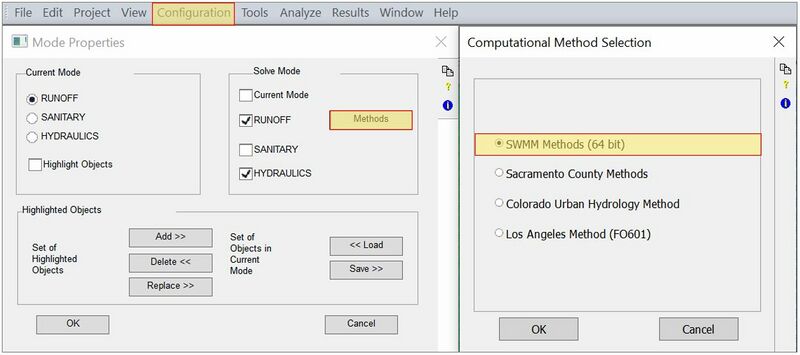
- Check whether the SWMM Hydrology runoff method has been used in your XPSWMM model by reviewing the selection from the following model settings: Configure > Mode Properties > Solver Mode > Methods
- Select the Hydraulics mode:
 .
.
- Convert 1D XPSWMM hydraulics features into a EPA SWMM 5 INP file format for TUFLOW:
- From the XPSWMM top drop menu select File > Import/Export Data > Export to EPASWMM5
- When prompted if you wish to save changes, select Yes.
- The exported INP file will be saved to the same folder and .XP project file.
- In QGIS in the Processing Toolbox, go to TUFLOW >> SWMM and select GeoPackage Create from SWMM inp. Enter the field below into the dialog box:
- SWMM Input File (inp): Select the recently exported INP file in the .XP project file.
- CRS for GeoPackage: Select an appropriate Coordinate Reference System for your model.
- GeoPackage output filename: Save the file to the TUFLOW\model\swmm folder, add "RNF" to the XP exported filename to distinguish this file from the HDR GeoPackage.
- Select 'Run'.
- Before Opening the RNF GeoPackage file in QGIS we have to delete the Nodes--Junctions Layer within it. It is a duplicate of the Nodes--Junctions Layer contained in the HDR GeoPackage file.
- From the QGIS drop menus, Select View > Panels. Tick Browser Panel.
- In the Browser Panel view the Layer tree associated with RNF GeoPackage file. Right click Nodes--Junctions Select Manage > Remove Layer
- After making the above change, open the RNF GeoPackage file in QGIS and review the attribute data. Note: For hydrology, TUFLOW has more advanced, workflow efficient "Event Scenario Management" options than XPSMM. If your project requires the simulation of multiple hydrology events, please complete TUFLOW SWMM Module 4 (1D SWMM Pipe Network / 1D SWMM Urban Hydrology: Executing multiple different event simulations from a single model control file). and use the model design concepts in it to upgrade the configuration of your TUFLOW model to accommodate for the simulation of multiple events from a single model.


Video
Update SWMM Nodes--Junction Attributes
The final GIS feature update that is necessary to finalise the SWMM portion of the TUFLOW model relates to the Nodes---Junctions attributes. This is typically the final model bulid step because the recommended Junctions attributes varies depending on whether the Junction is associated with inlet usage connections, 1D/2D culvert connections and SWMM hydrology sub-catchments.
- In the QGIS Layers Panel, select (left click) Nodes--Junctions and toggle on editing.
- In the Processing Toolbox, select the 'Edit Features In-Place' tool. This allows the editing of an existing layer, instead of the creation of a new layer.
- Go to TUFLOW >> SWMM in the processing tool list and select 'Junctions - Set attributes ' processing tool. This opens the dialog shown below.
Dialog Recommended Parameter Value Comment Input Subcatchments: Hydrology--Subcatchments Input is optional - only use if Hydrology Subcatchment Layers exist Input Inlet Usage Layers: swmm_iu_TS02_001 Input is optional - only use if Inlet Usage Layers exist Input BC Connection Layers 2d_bc_SWMM_Culvert_Connections_001_L Input is optional - only use if BC Connection Layers exist General Options Maximum Depth Option (Ymax) Set to 0.0 - Nodes receiving subcatchment flows option
(if connected to 2D):Set Apond = 0.0; Ksur = 0.0
(overwrites options below)- Nodes connected to 2D without Inlets: Ysur: 0 - Area of ponding: 50 This value should match the 2D cell area associated with 1D/2D culvert connections. Nodes connected to the 2D with Inlets: Maximum depth: 'Use global option' - Ysur: 0 - Area of ponding: 9 This value should match the 2D cell area associated with the Inlet Usage connections Nodes without a 2D connection: Surcharge Depth: 99 This entry should equal a value higher than any expected water level in the model Area of ponding: 1 -
- Select 'Modify All Features'.
- Once the tool has finished, click 'Close'.
- Turn off editing to save the edits.
- View the attributes associated within Nodes--Junctions to verify the data processing has been completed correctly.
For a summary of the attributes associated with the Nodes--Junctions layer, refer to TUFLOW 2023-03-AD Release Notes (Table A.30) and the SWMM Reference Manual - Volume 2 (Hydraulics).
Video
Export INP Files
Emilie, I haven't worked on the text below. All the INP file need to be exported before they are useed- you're welcome to write something here if you feel confident doing it
Link 1D SWMM and 2D TUFLOW Model
Emilie, I haven't worked on the text below (it was Pavlina's notes)- you're welcome to if you feel confident doing it
The linking is specified in the TUFLOW control files. Further commands can be added in or removed based on the modeling task.
- Create TUFLOW SWMM Control File (TSCF):
- Read SWMM == ..\swmm\original_model.inp
- Read SWMM == ..\swmm\inlet_definition.inp.inp
- Read SWMM == ..\swmm\subcatchments.inp
- Read SWMM Inlet Usage == ..\swmm\inlet_usage_information.gpkg
<<Video>>
- Update TUFLOW Boundary Control file (TBC):
- Add non-inlet 1D/2D links:
- Read GIS BC == ..\gis\2d_bc_1d2d_links.gpkg
<<Video>>
- Update main TUFLOW control file (TCF):
- Add below commands if applicable:
- Solution Scheme == HPC
- Hardware == GPU
- GIS Format == GPKG
- Add TSCF command to read the 1D SWMM features:
- SWMM Control File == ..\swmm\SWMM.tscf
- Add time control comands:
- Start Time == <<start_time>>
- End Time == <<end_time>>
- Rarely used options to consider removing from the TCF:
- SX ZC Check == OFF
- HX ZC Check == OFF
- Mass Balance Corrector == OFF
- Remove XPSWMM references:
- Read GIS XP Nodes ==
- Read GIS XP WLL ==
- Read GIS XP NETWORK ==
- Add scenarios/events if applicable
<<Video>>
Feedback / Suggestions
If you have any suggestions to be included in these pages, please email support@tuflow.com.
| Up |
|---|
 Back to Main Page Back to Main Page
|